The Attack Surface of a REST API
A REST API (Representational State Transfer) exposes HTTP endpoints that allow clients (web apps, mobile apps, third-party services) to access a server's data and features. Every endpoint is a potential door for an attacker. The attack surface includes:
- Exposed endpoints: every unprotected route can be called by anyone.
- Data in transit: if HTTPS is not enforced, requests can be intercepted.
- Data in the database: SQL injection or poor input validation can expose the entire database.
Authentication vs Authorization
Two fundamental concepts that are often confused:
- Authentication: verifying identity — "Who are you?" The user or service proves they are who they claim to be.
- Authorization: verifying rights — "What are you allowed to do?" Once identity is established, the system determines which resources and actions are accessible.
An API can correctly authenticate a user but allow them to access resources that do not belong to them — this is the IDOR (Insecure Direct Object Reference) vulnerability, very common in the OWASP API Top 10 ranking.
API Keys: Simple and Effective
API keys are opaque tokens generated by the server and transmitted in a dedicated HTTP header:
GET /api/v1/users HTTP/1.1
X-API-Key: sk_live_abc123xyz...
Advantages: simple to implement and understand. Disadvantages: no native expiration mechanism, no identity information (who is using this key?). Best practices:
- Rotate keys regularly.
- Generate separate keys per environment (dev, staging, prod).
- Never expose a key in versioned source code.
JWT: Signed Stateless Tokens
A JWT (JSON Web Token) is a self-describing token made of three Base64-encoded parts separated by dots: header.payload.signature.
- The header specifies the signing algorithm (HS256, RS256, etc.).
- The payload contains claims (user ID, roles, expiration).
- The signature guarantees integrity — a modified token will be rejected.
Important warnings: the payload is encoded, not encrypted — never store sensitive data in it. Always verify the signature server-side. Set a short expiration (exp) and plan a refresh token mechanism.
OAuth 2.0: Authorization Delegation
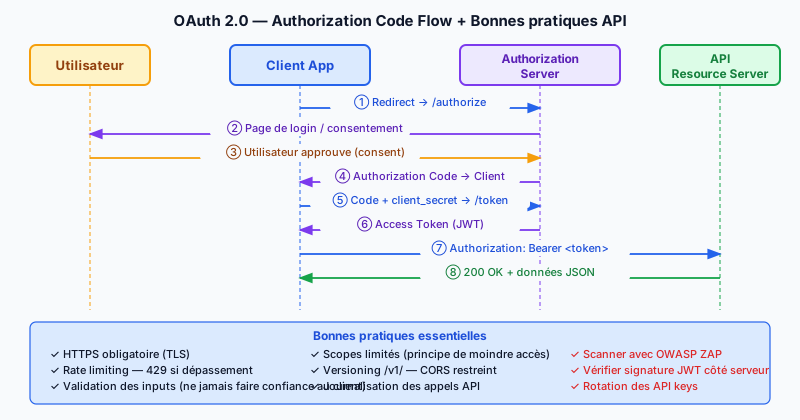
OAuth 2.0 is an authorization delegation framework that allows an application to access resources on behalf of a user without knowing their password. Two main flows:
- Authorization Code Flow: for web applications with a backend. The user authenticates with the authorization server, which returns a code exchangeable for an access token. This is the most secure flow.
- Client Credentials Flow: for machine-to-machine (M2M) communication, with no user involved. The application authenticates directly with its client_id and client_secret.
Essential Best Practices
Beyond authentication, several practices are indispensable:
- HTTPS mandatory: all communications must be encrypted with TLS (Transport Layer Security).
- Rate limiting: limit the number of requests per period (respond with 429 Too Many Requests when exceeded) to prevent brute-force attacks and abuse.
- Input validation: validate and sanitize all received data — never trust client data.
- Principle of least privilege: OAuth scopes and permissions must be limited to the strict minimum.
- Versioning: prefix routes with
/v1/to enable evolution without breaking existing clients. - Correct CORS configuration: restrict allowed origins, never use
*in production. - Logging: log all API calls with identifier, timestamp, and status to enable auditing.
- Security testing: use OWASP ZAP (Zed Attack Proxy) or Burp Suite to scan your endpoints.
Audit Your API Security
Poorly secured APIs are a prime target for attackers — and vulnerabilities are often invisible from the outside. Run a free audit to assess your API's exposure and get a detailed report of vulnerabilities to fix.