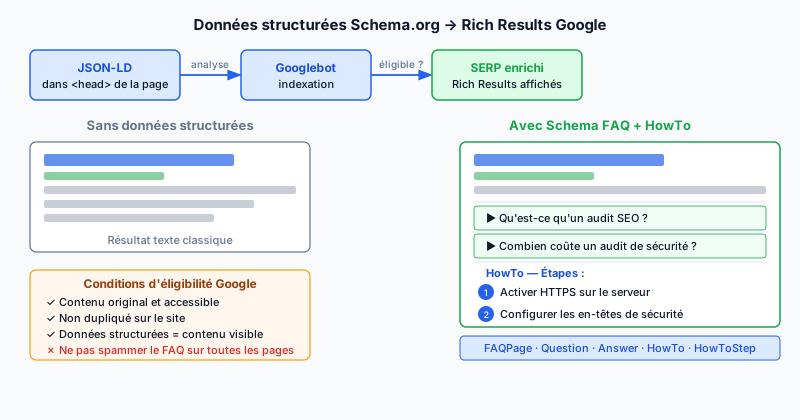
Recap: Schema.org and JSON-LD
Schema.org is a structured data vocabulary created by Google, Bing, Yahoo, and Yandex to help search engines understand page content. The recommended syntax is JSON-LD (JavaScript Object Notation for Linked Data), a <script type="application/ld+json"> block inserted into the page's <head>. Unlike microdata or RDFa, JSON-LD does not require modifying the existing HTML.
Rich results go beyond classic rich snippets: they add interactive elements visible directly in the SERPs (Search Engine Results Pages), such as question accordions or numbered steps.
FAQ Schema: Accordion in Google Results
The FAQPage type tells Google that a page contains a list of questions and answers. When Google deems the page eligible, it displays an accordion below the main link, with 2 to 3 expandable questions directly in the search results.
{
  "@context": "https://schema.org",
  "@type": "FAQPage",
  "mainEntity": [
    {
      "@type": "Question",
      "name": "What is an SEO audit?",
      "acceptedAnswer": {
        "@type": "Answer",
        "text": "An SEO audit analyzes technical factors..."
      }
    }
  ]
}
Questions must come from actual page content. Answer text may include basic HTML (links, lists).
HowTo Schema: Numbered Steps
The HowTo type describes a step-by-step process. It is especially valued on mobile and in Google Assistant. Each step (HowToStep) can include a name, a description, and an optional image.
{
  "@context": "https://schema.org",
  "@type": "HowTo",
  "name": "How to secure your website",
  "step": [
    {
      "@type": "HowToStep",
      "name": "Enable HTTPS",
      "text": "Install a TLS certificate on your server..."
    },
    {
      "@type": "HowToStep",
      "name": "Configure security headers",
      "text": "Add Content-Security-Policy, X-Frame-Options..."
    }
  ]
}
Google Eligibility Requirements
Google only displays rich results when certain conditions are met:
- Content must be original and provide real value to users.
- Content must not be duplicated across multiple pages of the same site.
- The page must be accessible without registration (no content behind an unindexable paywall).
- Structured data must accurately match the content visible on the page — marking hidden content is prohibited.
Testing and Validating Your Structured Data
Two official tools allow you to verify your implementations:
- Rich Results Test (search.google.com/test/rich-results): tests a URL or code snippet and indicates whether the page is eligible for rich results, with a list of detected errors.
- Schema Markup Validator (validator.schema.org): validates conformance with the Schema.org vocabulary, independently of Google's rules.
Google Search Console also provides a dedicated structured data report, showing errors and impressions generated.
Common Mistakes to Avoid
Google significantly reduced FAQ rich result display in 2023 to combat spam. Mistakes that lead to penalties or ineligibility:
- Adding FAQ schema to every page without real FAQ content — considered spam.
- Answers that are too short or lack informational value.
- Duplicate content across multiple FAQPage-marked pages.
- For blogs, prefer the Article type (
author,datePublished,headline), which remains stable and improves Google's understanding of your content.
Get More Visibility in Google
Well-implemented structured data can double your display surface in the SERPs. Run a free audit to check whether your pages are eligible for rich results and identify missed Schema.org opportunities on your site.