What Is OWASP?
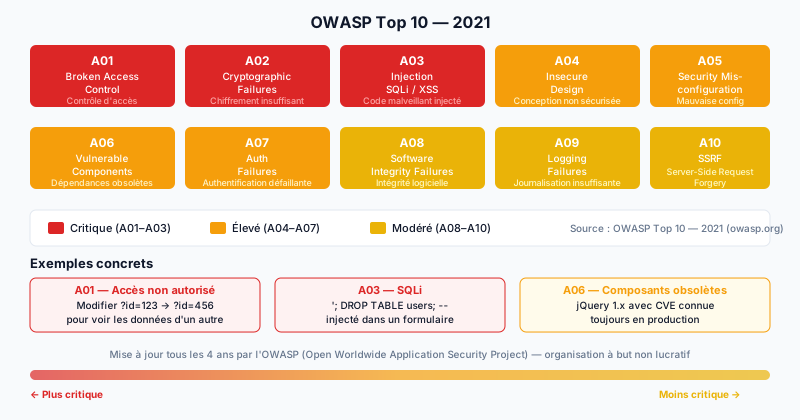
OWASP (Open Worldwide Application Security Project) is a non-profit organization dedicated to improving software security. Its best-known document, the OWASP Top 10, identifies the ten most critical security risks for web applications. It is updated approximately every four years — the current version dates from 2021 — and serves as the industry standard reference.
A01 to A05: The First Five Risks
- A01 — Broken Access Control: a user can access resources they are not authorized for. Example: modifying an ID in a URL to view another customer's data.
- A02 — Cryptographic Failures: sensitive data transmitted or stored without adequate encryption. Example: passwords stored in plain text in the database.
- A03 — Injection: malicious data interpreted as code. The two most common forms are SQL Injection (SQLi), which manipulates database queries, and XSS (Cross-Site Scripting), which injects JavaScript into pages viewed by other users.
- A04 — Insecure Design: absence of security controls from the application's design phase. Example: no limit on authentication attempts.
- A05 — Security Misconfiguration: default settings left unchanged, unnecessary features enabled. Example: admin interface publicly accessible.
A06 to A10: The Next Five Risks
- A06 — Vulnerable and Outdated Components: libraries, frameworks, or dependencies not updated, containing known vulnerabilities. Example: a version of jQuery with a published XSS vulnerability.
- A07 — Identification and Authentication Failures: insufficient session and credential management. Example: no account lockout after multiple failed attempts, predictable session tokens.
- A08 — Software and Data Integrity Failures: code or data modified without verification. Example: a CI/CD (Continuous Integration/Continuous Deployment) pipeline executing code from unverified sources.
- A09 — Security Logging and Monitoring Failures: absence of security event traces. Without logs, an intrusion can go undetected for months. Example: failed login attempts not recorded.
- A10 — SSRF (Server-Side Request Forgery): the application makes requests to URLs controlled by the attacker. Example: fetching AWS cloud server metadata via a user-supplied URL.
How to Prioritize Fixes
Faced with ten risks, it's tempting to fix everything at once. The best approach is to start with the top-ranked risks (A01, A02, A03) because they combine high frequency with critical impact. Then address outdated components (A06), which often have patches immediately available, followed by configuration issues (A05), which are typically the fastest to resolve.
Security Audit with TheSiteFuse
A security audit covers several OWASP Top 10 risks: verification of HTTP security headers (A05), detection of outdated libraries (A06), analysis of exposed authentication policies (A07), and verification of HTTPS/TLS configuration (A02). Run a free audit to get an initial assessment of your site's exposure to the most common OWASP risks.