Why Does Internal Linking Matter?
Internal linking refers to all hyperlinks that connect your own pages to each other within your domain. It serves three fundamental roles:
- Internal PageRank distribution — Google still uses the concept of PageRank (value passed through links) between your pages. A link from a strong page to a lesser-known one transfers part of its authority.
- Googlebot discoverability — Google's crawl bot follows links to discover your pages. A page with no inbound links (orphan page) risks never being indexed. The crawl budget (crawling quota allocated to your site) is better used when your link architecture is logical.
- User Experience (UX) — Contextual links guide visitors toward complementary content, reducing bounce rate and increasing time on site.
Silo Architecture and Hub-and-Spoke
Two link architecture models are particularly effective for SEO:
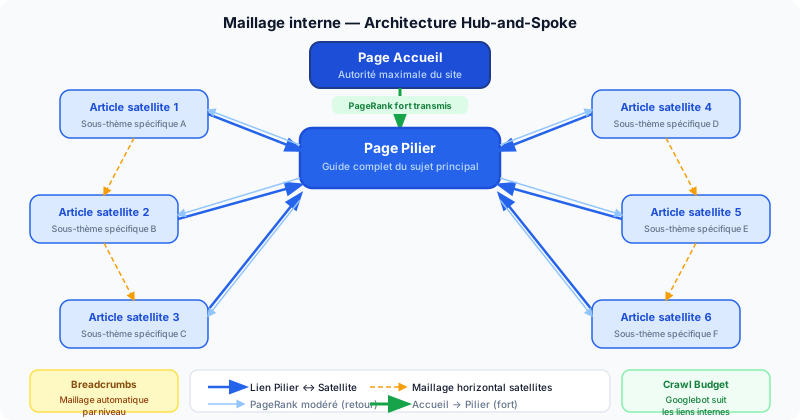
The hub-and-spoke model organizes content around a pillar page (hub) that covers a topic in depth, surrounded by satellite articles (spokes) that explore specific sub-topics. Each satellite links to the pillar, and the pillar links to each satellite. This model creates topic clusters (groups of content on the same subject) that Google rewards.
The silo model (or semantic cocoon) isolates topics: links stay within a thematic silo to concentrate SEO power on each subject.
Anchor Text: An Underrated Signal
Anchor text — the clickable text of a link — tells Google what the destination page is about. A descriptive and varied anchor is far more effective than generic phrasing.
- Avoid: "click here", "learn more", "read the article"
- Prefer: "optimize the Critical Rendering Path", "SEO internal linking guide"
Vary the phrasing for the same link to appear natural to Google.
Deep Links and Orphan Pages
Deep links point directly to specific internal pages rather than to the home page or general categories. They are particularly valuable for orphan pages — indexed pages with no inbound internal links. A link audit consistently reveals dozens of such pages ignored by Googlebot.
Breadcrumbs (navigation trails) provide automatic, structured internal linking, doubly useful: for UX and as a source of links for each level of the hierarchy.
Technical Best Practices
- Avoid
nofollowinternally — therel="nofollow"attribute on an internal link blocks PageRank transfer to your own content: it is counterproductive. - Number of links per page — Google sets no official limit, but beyond 100 links per page, crawl budget can be diluted. Stay below that for important pages.
- Audit tools — Screaming Frog lets you export a complete map of your internal links. Ahrefs offers an "Internal Links" report that identifies orphan pages and under-linked pages.
Strengthen Your SEO Architecture
Is your site making the most of its internal linking? Run a free audit to map your internal links, detect orphan pages and identify untapped PageRank opportunities.