The Legacy Problem with TCP
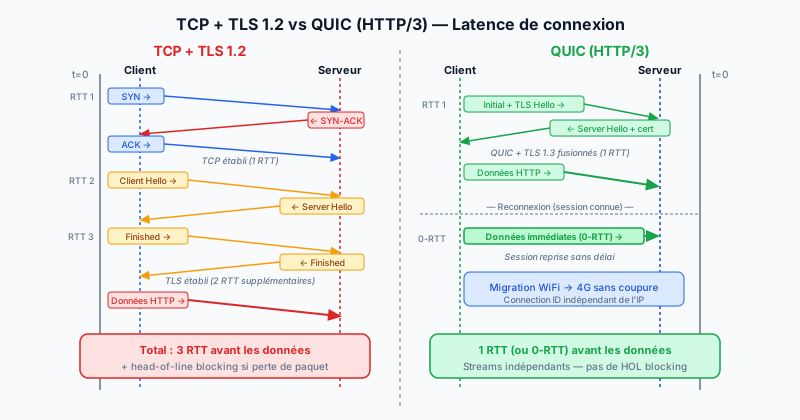
For decades, the web has relied on TCP (Transmission Control Protocol — a reliable transport protocol guaranteeing ordered packet delivery). Before sending any HTTP data, TCP requires a 3-way handshake (SYN, SYN-ACK, ACK), followed by the TLS (Transport Layer Security) handshake for HTTPS encryption — resulting in 2 to 3 network round trips (RTT, Round-Trip Time) of incompressible latency. On a mobile connection with 100ms RTT, that is 200 to 300ms before the first useful byte.
TCP also suffers from head-of-line blocking: if a packet is lost, all subsequent packets — even those belonging to independent resources — are held up waiting for retransmission.
QUIC: Google's Solution
QUIC (Quick UDP Internet Connections) was designed by Google in 2012 and standardized by the IETF (Internet Engineering Task Force) as RFC 9000 in May 2021. It runs over UDP (User Datagram Protocol — a connectionless protocol, lighter than TCP) while natively integrating TLS 1.3. This choice is deliberate: UDP avoids OS kernel constraints tied to TCP, allowing reliability mechanisms to be implemented at the application level.
Latency Gains: 1-RTT and 0-RTT
With QUIC, the first connection requires only one round trip (1-RTT) because the QUIC handshake and TLS 1.3 handshake are merged. For reconnections to a previously visited server, QUIC supports 0-RTT (zero round trips) mode: the client immediately sends data using cryptographic parameters from the previous session. Data flows without any establishment delay.
Note: 0-RTT carries a theoretical replay attack risk — limit its use to idempotent GET requests.
Multiplexing Without HOL Blocking
HTTP/2 had already introduced multiplexing (multiple simultaneous requests on a single TCP connection), but TCP head-of-line blocking persisted at the transport layer. With QUIC, each stream (data flow) is independent: losing a packet only affects that stream, not others. A site with 20 parallel resources sees notable gains on high-packet-loss networks (mobile, public WiFi).
Connection Migration
QUIC supports connection migration via a Connection ID independent of the IP address. When you switch from WiFi to 4G, your QUIC connection survives the IP address change without interruption. With TCP, an IP address change broke the connection and forced a full reconnection.
Support and Deployment in 2025
In 2025, over 75% of browsers support HTTP/3. Cloudflare enables it by default on all its domains. Servers advertise HTTP/3 support via the HTTP header Alt-Svc: h3=":443"; ma=86400, signaling to the browser that it can use QUIC for future connections. Nginx and Apache support HTTP/3 via dedicated modules.
Optimize Your Performance with TheSiteFuse
HTTP/3 can significantly reduce your TTFB (Time to First Byte — time before the first received byte) and improve the mobile experience. Run a free audit to check whether your server supports HTTP/3 and identify performance bottlenecks.