What is Schema.org?
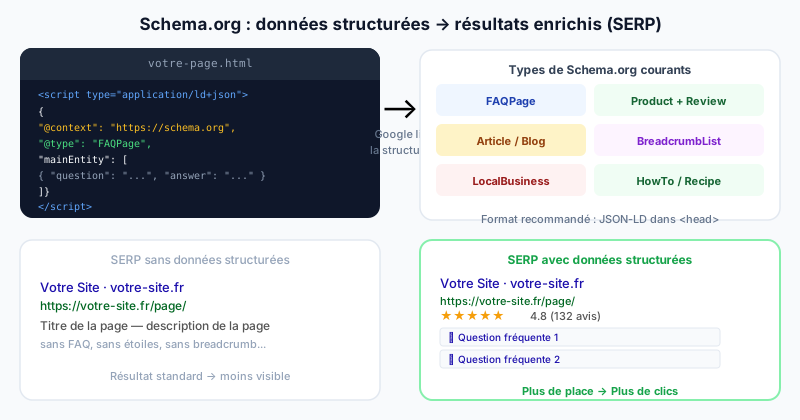
Schema.org is a standardised vocabulary, co-created by Google, Bing, Yahoo and Yandex, to describe the semantics of your web pages' content in a machine-readable way. Structured data are metadata added to your HTML that allow search engines to precisely identify what your content represents: an article, a product, a FAQ, a local business, a recipe…
When used correctly, they give access to rich snippets — enhanced results in the SERP (Search Engine Results Pages): review stars, prices, FAQ accordions, breadcrumbs, preparation times for recipes. These enhancements significantly increase the CTR (Click-Through Rate).
The recommended format: JSON-LD
JSON-LD (JavaScript Object Notation for Linked Data) is Google's preferred format because it is easy to maintain (a block independent of the visible HTML), easy to validate, and does not require modifying existing HTML code. It is placed in a <script> tag in the <head>.
The most useful types
FAQPage — question accordion
Displays up to 3 questions directly in Google results, taking 2–3 times more space than a standard result.
Product — e-commerce products
Displays price, availability and review stars directly in results, including Google Shopping.
BreadcrumbList — breadcrumb trail
Displays the navigation path (Home > Blog > Article) below the title in Google results.
Validate your structured data
- Rich Results Test (search.google.com/test/rich-results): tests a URL or HTML and shows which rich snippets are eligible
- Schema Markup Validator (validator.schema.org): validates syntax
Errors to avoid
- Data must match visible content — Google penalises manipulation
- Always include required properties for each type
- Don't mark as
FAQPagequestions whose answers aren't on the page
Check your structured data
TheSiteFuse detects Schema.org structured data and validates their format. Run a free audit to find out if your site is eligible for Google rich snippets.